Restrictive and Nonrestrictive Clauses: The Comma Rule That Changes Everything
I once sent a whitepaper to a client with this sentence:
He replied: "Wait — you have more than one editor?"
I didn't. But those two commas told him I did. That one mistake taught me more about restrictive and nonrestrictive clauses than any grammar book ever could.
If you've ever frozen mid-sentence wondering, "Does this need a comma before 'which' or not?" — this ultimate guide ends that confusion for good.
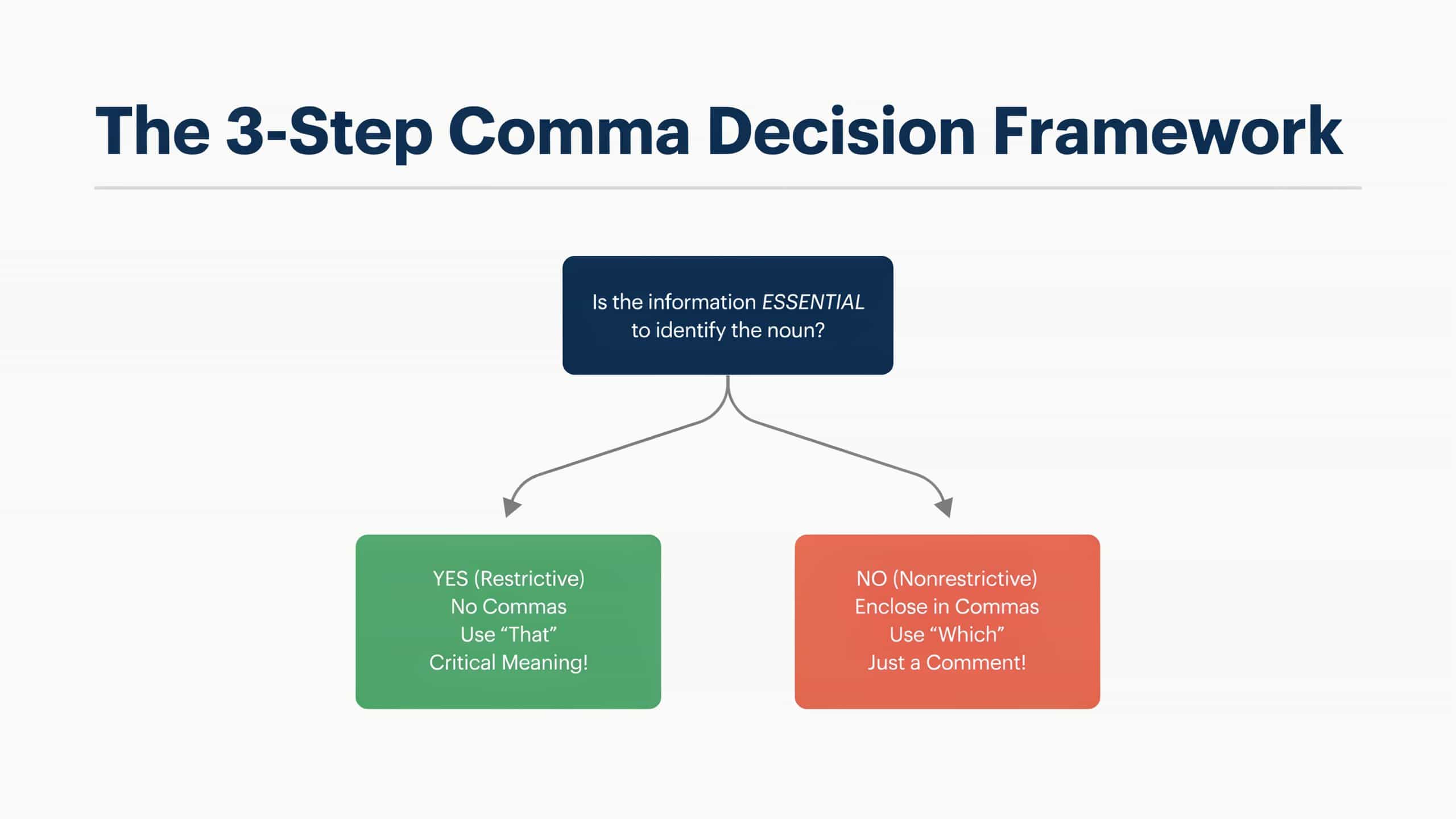
Restrictive clauses identify exactly which noun you mean (no commas). Nonrestrictive clauses add extra information about an already-identified noun and are set off with commas.
What Are Restrictive and Nonrestrictive Clauses? (Simple Definition)
Let's break down the technical jargon into plain English.
- A restrictive clause limits or identifies exactly which noun you mean. It is an essential clause (or defining clause). Remove it, and the sentence either falls apart or says something completely different.
- A nonrestrictive clause adds extra, bonus detail about a noun that is already clearly identified. It is a nonessential clause (or non-defining clause). Remove it, and the core sentence survives perfectly intact.
For more on comma rules in English, check out our complete guide. And if you're curious about the Oxford comma, we've got that covered too.
The Removal Test: How to Identify a Nonrestrictive Clause Every Time
Most grammar guides dump confusing definitions and leave you stranded. Here is the exact, bulletproof test professional editors use every single time:
Read your sentence. Mentally pull out the clause (the part starting with who, which, or that).
• Does the core meaning change or become vague? Yes → It is a restrictive clause. No commas.
• Does the sentence still make perfect sense? No → It is a nonrestrictive clause. Add commas.
Restrictive Modifier Example (No Commas):
Apply the Removal Test: "The employee got promoted." Which employee? The sentence loses its specific identity. The clause is critical.
Nonrestrictive Modifier Example (With Commas):
Apply the Removal Test: "Sarah got promoted." The sentence is still perfectly clear because Sarah is already identified by her name. The clause is just a casual comment.
Restrictive vs Nonrestrictive Relative Clause Comparison Table
| Feature | Restrictive Clause | Nonrestrictive Clause |
|---|---|---|
| Alternative Names | Essential clause, Defining clause | Nonessential clause, Non-defining clause |
| Punctuation Rules | Strictly No Commas | Required parenthetical commas |
| Is it Removable? | No—the meaning changes completely | Yes—the core meaning holds intact |
| US English Pronoun | that or who | which or who |
| UK English Pronoun | that, which, or who | which or who |
| Classic Example | The file that you deleted is gone. | The file, which you deleted, is gone. |
Side-by-Side Examples That Actually Show the Difference
1. The Brother Test
No Commas: My brother who lives in Karachi is visiting. (Implies I have multiple brothers, and I am specifying the one in Karachi).
With Commas: My brother, who lives in Karachi, is visiting. (I have exactly one brother. The fact that he lives in Karachi is just bonus information).
2. The Students Rule
No Commas: Students who fail the exam must retake the course. (Only the specific students who failed must retake it).
With Commas: Students, who fail the exam, must retake the course. (This bizarrely implies that all students fail the exam, and therefore all must retake it).
3. The File Deletion Nightmare
No Commas: Please delete the files that are marked temporary. (Delete only the temporary ones).
With Commas: Please delete the files, which are marked temporary. (Delete every single file in the folder—they just happen to be temporary).
Catch Comma Mistakes Before They Cost You
Not sure if you need that comma? Grammarify catches restrictive/nonrestrictive errors instantly.
Try Grammarify Free →That vs. Which: The Grammar Rule Nobody Explains Clearly
If you write for global clients, you need to understand regional conventions.
American English (Chicago Manual & AP Style):
Use that for restrictive clauses and which for nonrestrictive clauses (always preceded by a comma).
British English (Cambridge & Commonwealth):
Which is perfectly acceptable for both restrictive and nonrestrictive adjective clauses. Punctuation and context do all the heavy lifting.
⚠️ One Rule That Never Flips: "That" is always restrictive. Unlike which (which can go either way depending on commas), that never introduces a nonrestrictive clause.
The 5 Mistakes Writers Make Most Often
- Placing commas around a restrictive clause
❌ The students, who passed, received certificates.
✅ The students who passed received certificates. - Forgetting the closing parenthetical comma
❌ My colleague, who joined last year works remotely.
✅ My colleague, who joined last year, works remotely. - Using which without a comma for a restrictive clause in US English
❌ The rule which applies here is simple.
✅ The rule that applies here is simple. - Using that to refer to people in formal contexts
❌ The analyst that wrote the report resigned.
✅ The analyst who wrote the report resigned. - Treating an appositive clause as optional trivia
❌ The passport, that expires next month, must be renewed.
✅ The passport that expires next month must be renewed.
Commas = Comment. No Commas = Critical.
If the clause is just a casual comment on something already identified → use commas. If the clause is critical to knowing which noun you are talking about → no commas.
📝 Test Your Knowledge
10 questions. One at a time. Submit email to see your score.
FAQ
Yes for nonrestrictive clauses in US usage: use a comma before which when the clause adds extra information; do not use a comma when which introduces an essential (restrictive) clause—though US style typically prefers that for restrictive uses.
Restrictive clauses define which noun you mean and need no commas; nonrestrictive clauses add nonessential information and require commas.
In US style, use that for restrictive clauses (no commas) and which for nonrestrictive clauses (with commas). British usage allows which in both roles more freely.
Remove the clause. If the sentence becomes vague or changes meaning, it's restrictive. If it still reads clearly, it's nonrestrictive.
Most AI grammar tools rely on pattern matching, not true context understanding. They often flag correct restrictive clauses as "missing commas" because they can't distinguish between essential and nonessential information. Grammarify uses a smarter contextual engine that applies the Removal Test logic, giving you accurate guidance without false positives—saving you from "correcting" perfectly fine sentences.
The Removal Test is your best friend. Memorize: "Commas = Comment (extra info). No commas = Critical (essential to identify)." Practice with minimal pairs: "My brother who lives in Karachi" (implies multiple brothers) vs "My brother, who lives in Karachi" (only one brother). Unlike many languages, English uses comma placement to shift meaning—train yourself to hear the difference, and Grammarify can help flag ambiguous cases.
Restrictive and nonrestrictive clauses aren't arbitrary grammar rules. They dictate how readers automatically process meaning. Every time you place commas around a clause, you tell your reader: "You already know exactly what I mean. This is just extra." Every time you skip the commas, you say: "Pay attention, you need this clause to understand the subject." Once you look at punctuation as a tool for precision rather than a set of rules to memorize, your writing immediately gains a level of authority that clients and readers instinctively trust.
Need Custom Content or Editing Help?
Whether you need a blog post written, your work edited, or just some grammar guidance — I'm here to help.
💡 Support & Inquiries: Questions, guidance, or personalized content – I've got you covered! (I reply within 24 hours)