Most writers don't struggle with commas because they're careless. They struggle because nobody ever explained the logic behind them — just the rules, listed without reason. I used to be one of those writers. Early in my career, I'd sprinkle commas wherever a sentence felt like it needed to breathe. Sometimes I was right. Often I wasn't. It took years of editing, proofreading client copy, and reading style guides cover to cover before I realized something: commas aren't random. Every placement decision has a test you can run in under ten seconds.
If you are looking for a comprehensive overview of all punctuation marks beyond commas, explore our master hub on Punctuation marks, which acts as the core architecture for our entire editorial framework. This guide covers all of it — when to use a comma, when to skip one, and how to fix the mistakes that quietly damage your credibility in professional writing.
What Are Comma Rules? (Quick Definition)
Comma rules are the grammatical guidelines that determine where a comma is placed within a sentence to control clarity, pacing, and meaning. Commas separate elements, signal pauses, and prevent misreading — but only when placed correctly. A comma in the wrong spot doesn't just look wrong. It changes what the sentence means.
There are roughly 8 core comma rules in English, plus a set of special cases for dates, quotations, addresses, and direct address. We'll cover all of them, grouped by function so you can actually use them.
Rule 1: Joining Independent Clauses (Comma + Coordinating Conjunction)
When you join two independent clauses — two complete sentences — with a coordinating conjunction (for, and, nor, but, or, yet, so — the FANBOYS), place a comma before the conjunction. For a deeper look at separating full thoughts without creating structural errors, read our analysis on the comma before coordinating conjunction.
No comma needed when both sides share the same subject and there's no second independent clause:
Quick test: Can both sides of the conjunction stand alone as full sentences? If yes — comma. If no — skip it.
Rule 2: After Introductory Phrases and Clauses
When a sentence opens with an introductory element — a phrase, clause, or adverb — follow it with a comma before the main clause. To master punctuation at the very beginning of your sentences, see our comprehensive breakdown on the comma after introductory elements phrase clause.
Short introductory phrases (under four words) are a gray area. Technically, you can skip the comma. In practice, I always include it for clarity. "In 2019 everything changed" is harder to read than "In 2019, everything changed."
The comma after introductory elements is one of the most commonly skipped rules in business writing. It's also one of the easiest to fix.
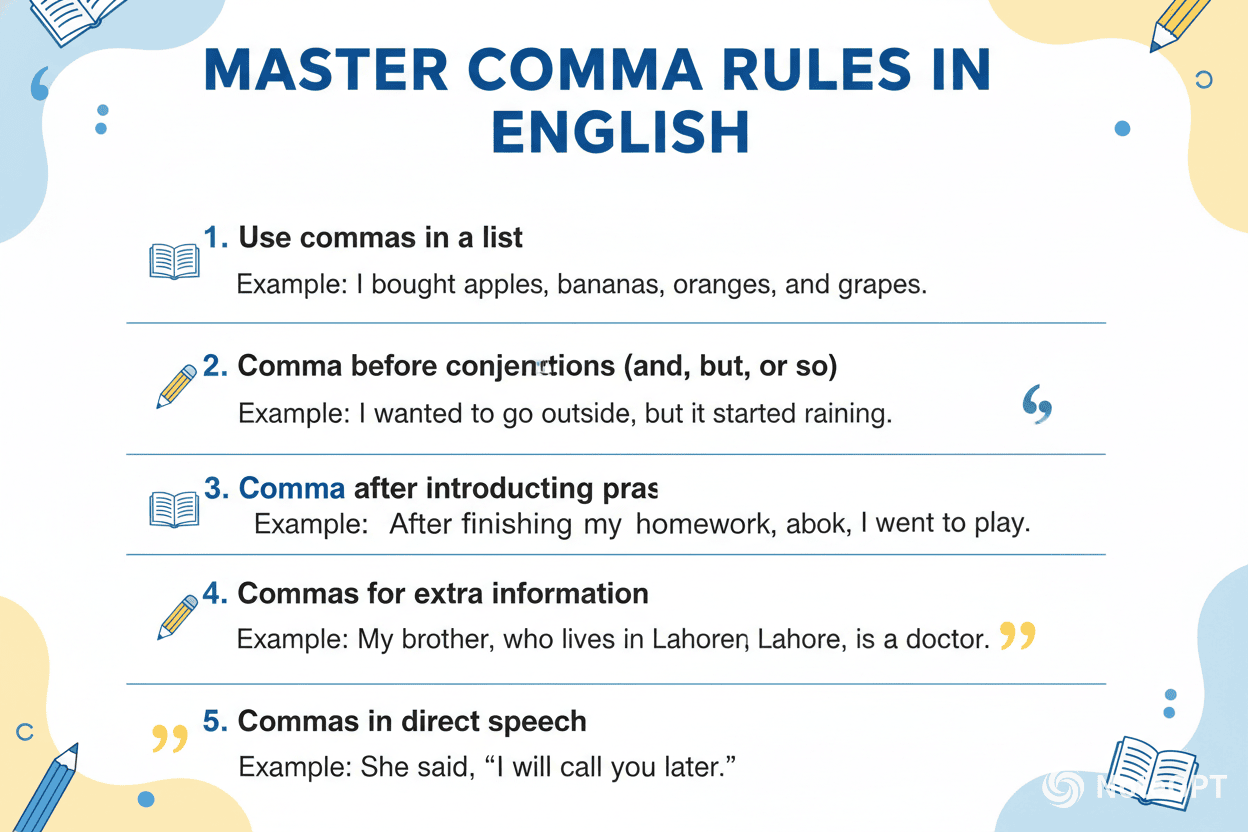
Rule 3: Commas in a Series (The Oxford Comma Debate)
When listing three or more items, separate each with a comma.
The comma before and in a series — the Oxford comma (also called the serial comma) — is optional in some style guides but strongly recommended for clarity. We break down when it is non-negotiable for editorial clarity in our guide to the oxford comma.
Here's why it matters:
My bold opinion: the Oxford comma should never be optional in professional writing. It exists specifically to prevent sentences like the one above. Use it every time.
Rule 4: Setting Off Nonrestrictive Clauses
This is where most writers get genuinely confused — and where most guides give the worst explanations. A nonrestrictive clause adds extra information that isn't essential to identifying the subject. Remove it, and the sentence still makes complete sense. These get commas on both sides. A restrictive clause is essential — it defines exactly which person or thing you mean. No commas. To clear up any confusion on identifying essential modifiers versus extra details, review our practical breakdown of the restrictive vs nonrestrictive clause.
The which vs that shortcut:
- Which typically introduces nonrestrictive clauses → use commas
- That typically introduces restrictive clauses → no commas
Quick test: Remove the clause. Does the sentence still identify who or what you mean? If yes → nonrestrictive → add commas. If no → restrictive → no commas.
Rule 5: Setting Off Parenthetical Elements, Interrupters, and Appositives
Words, phrases, or clauses that interrupt the main flow of a sentence — but aren't essential to it — get commas on both sides. These are called parenthetical elements. Similarly, an appositive renames or explains the noun directly beside it. To learn how to manage transitional words and structural breaks seamlessly, check out our master resource on parenthetical elements.
Common parenthetical expressions include words like however, therefore, moreover, in fact, of course, by the way, on the other hand, and for example.
- The "Such as" Rule: If such as adds extra examples, put a comma before it, but never after. (
...tools, such as Trello, are great.) - The "As well as" Rule: Treat phrases introduced by as well as as parenthetical elements if they add extra information. (
...the CEO, as well as the managers, attended.)

Rule 6: Coordinate Adjectives
When two adjectives independently modify the same noun, separate them with a comma.
To make sure you don't confuse these with cumulative descriptions that require no punctuation, read our specific guide on the comma between coordinate adjectives.
Quick test: Can you insert and between them, or reverse their order, without the sentence sounding strange? If yes — comma. If no — no comma.
Rule 7: Commas with Dates, Addresses, and Places
Dates
In the American format (month-day-year), use a comma after the day and after the year if the sentence continues.
Addresses and Places
Separate each distinct regional element with a comma — except between a state and a zip code. Ensure your invoices and corporate documents match global layouts by following our technical blueprint for the comma in dates and places.
Rule 8: Direct Address and Quotations
Direct Address
When you address someone directly by name or title inside a sentence, set off their name with commas. Avoid embarrassing punctuation errors by adhering strictly to the comma with direct address rule.
Quotations
In American English, the comma goes inside the closing quotation mark. In British English, the comma typically goes outside unless it's part of the original quote. Master international professional expectations via our look at the comma in direct speech and quotations.

When NOT to Use a Comma (Forbidden Commas)
This is the section most grammar resources bury at the bottom. I'm putting it here because these mistakes are just as common as missing commas — and sometimes more damaging.
Never separate a subject from its verb:
Never put a comma between a verb and its object:
Never add a comma after a conjunction:
Understanding and Fixing Comma Splices
A comma splice occurs when you join two independent clauses (complete thoughts) with only a comma and no coordinating conjunction. It is one of the most common clarity breakers in professional copy.
How to Fix a Comma Splice
You have three structural paths to fix a standard splice:
- Add a coordinating conjunction (FANBOYS): The proposal was strong, but the client rejected it anyway.
- Separate with a period: The proposal was strong. The client rejected it anyway.
- Use a semicolon: The proposal was strong; the client rejected it anyway.
The "However, Therefore, Moreover" Trap
Writers frequently create comma splices when using conjunctive adverbs (like however, therefore, moreover, furthermore, consequently). Because these words feel like transitions, writers mistakenly treat them like simple conjunctions.
The Rule: When these words join two complete sentences, you must use a semicolon before the word and a comma after it.
Comma vs. Semicolon vs. Conjunction — Which to Use?
When joining two independent clauses, consider this quick reference table for your sentence pacing:
| Option | Example | Best for |
|---|---|---|
| Comma + Conjunction | She wrote it, and he edited it. | Standard, readable flow |
| Semicolon | She wrote it; he edited it. | Closely related ideas, formal tone |
| Period | She wrote it. He edited it. | Maximum clarity and emphasis |
To deep dive into intermediate structural breaks beyond basic commas, read our comparative analysis on Semicolon vs. Colon vs. Dash.
Quick Proofreading Checklist for Comma Use
Before publishing any piece of writing, run through these checks:
- ✅ Does a comma appear before each FANBOYS conjunction joining two full sentences?
- ✅ Are introductory phrases and clauses followed by a comma?
- ✅ Are listed items separated by commas, with an Oxford comma before the final and or or?
- ✅ Are nonrestrictive clauses wrapped in commas on both sides?
- ✅ Are interrupters, parenthetical elements, and appositives enclosed properly?
- ✅ Are names used in direct address set off with commas?
- ✅ Are dates, addresses, and professional titles punctuated with commas?
- ✅ Is there no comma separating the subject from its verb or a verb from its object?
- ✅ Are there no comma splices — especially around words like however and therefore?
FAQ: Comma Rules
The Oxford comma isn't required in all style guides — AP Style traditionally omits it, while Chicago Style recommends it. That said, it prevents genuine ambiguity in complex lists and is strongly preferred in academic, legal, and editorial writing. For professional clarity, treat it as required.
No — this is one of the most common comma mistakes in professional writing. Never insert a comma between the subject and its main verb, even when the subject is long or complex. "The entire leadership team, approved the budget" is incorrect.
Remove the clause and read the sentence. If removing it changes which person or thing you're referring to, it's restrictive — no commas. If the sentence still clearly identifies the same subject without it, the clause is nonrestrictive — wrap it in commas.
It depends on how however is used. When it starts a sentence or interrupts one as a parenthetical, use a comma after it: However, the results improved. When it joins two independent clauses, use a semicolon before it and a comma after: The budget was tight; however, we delivered on time. Never use just a comma before however between two full sentences — that creates a splice.
In American English, commas always go inside the closing quotation mark, regardless of logic. In British English, they typically go outside unless the comma is part of the original quoted material. Choose one convention and remain consistent.
Commas are the most democratic punctuation mark in English. Every writer uses them — and nearly every writer misuses at least a few of them regularly. The difference between writers who earn trust on the page and those who don't often comes down to whether they've taken the time to understand not just the rules, but the why behind each one.
Master the logic, not just the list. Your writing will show it.
Need Custom Content or Editing Help?
Whether you need a blog post written, your work edited, or just some grammar guidance — I'm here to help.
💡 Support & Inquiries: Questions, guidance, or personalized content – I've got you covered! (I reply within 24 hours)