A missing comma once cost me a freelance client. The sentence read: "Let's eat, Sarah" became "Let's eat Sarah" in the final draft I sent over. She laughed — but she didn't hire me again.
That's the thing about punctuation. It's invisible when done right. It's catastrophic when done wrong.
Punctuation marks are symbols used in written language to clarify meaning, control sentence rhythm, and show relationships between ideas. They're not decorative. They're structural. Remove them, rearrange them, or misplace them — and even a brilliant sentence falls apart.
There are 14 standard punctuation marks in English. Most writers know five or six. The rest? They guess. This guide fixes that.
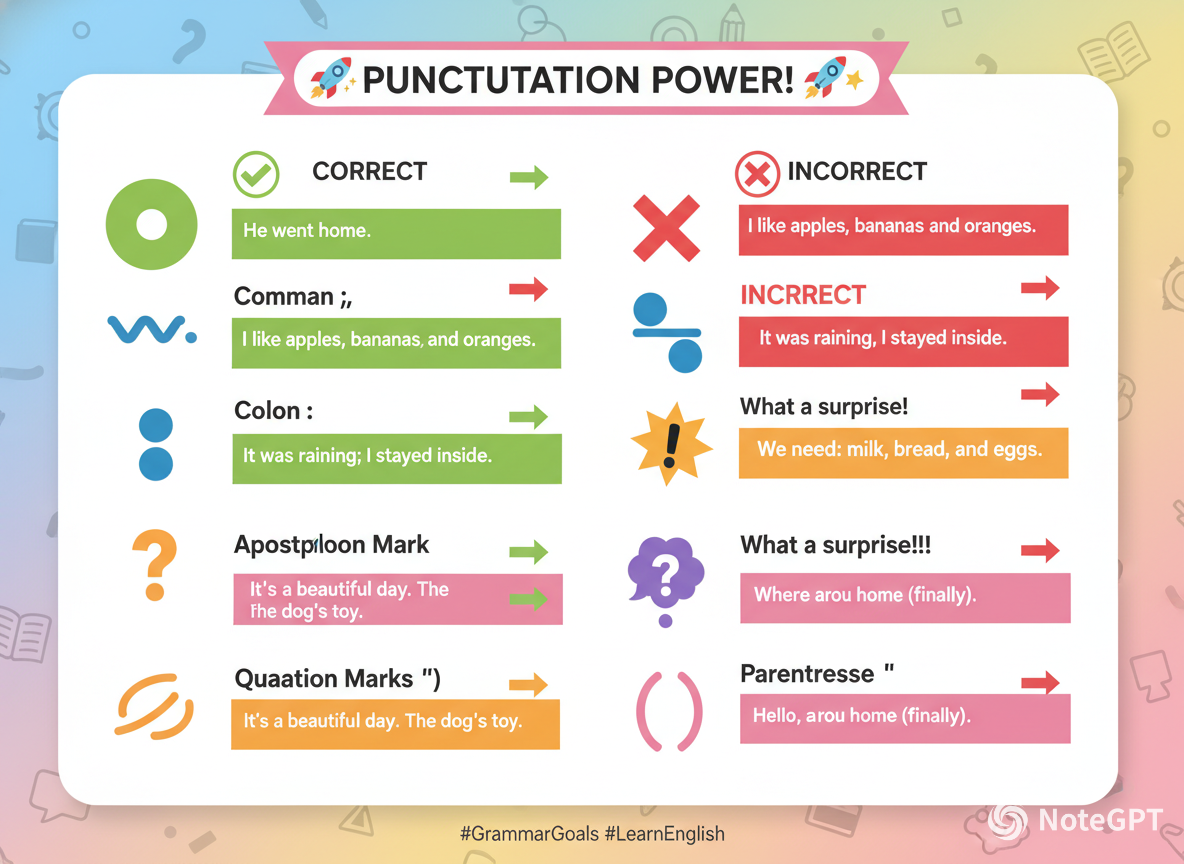
The 14 Punctuation Marks — What They Are and When to Use Them
Rather than a flat list, here's how these symbols actually group in practice — grouped by function, explained by behavior.
Basic Boundary Marks
These three marks do the same essential job: they signal where a sentence ends and what kind of sentence it was. Together, they define the sentence boundaries that organize every piece of writing — and understanding them is the first step toward solid grammar rules.
Period ( . )
The period is the most authoritative mark in English. It ends a declarative sentence with finality — no ambiguity, no emotion, no questions. It also appears in abbreviations (Dr., etc., U.S.) and initials. One firm rule: do not place a period after a heading, and skip it in bullet points that aren't complete sentences. The period's power comes from restraint. Use it to close a thought, then move on.
Question Mark ( ? )
The question mark ends a direct question and signals rising interrogation in the reader's mental voice. The rule most writers miss: never use it after an indirect question. "She asked whether I was ready" is a statement about a question — it gets a period, not a question mark. Reserve the question mark for sentences structured as genuine direct questions: "Is the draft ready?" If you're unsure which type of question you have, test it — can you answer with yes or no directly from the sentence structure? If the sentence starts with "She asked" or "He wondered," it's indirect.
Exclamation Point ( ! )
The exclamation point signals strong emotion, surprise, or urgency. My rule: one per page, maximum. Overuse makes your writing feel panicked rather than passionate. In professional copy, the exclamation point is a seasoning — not a main ingredient. In academic writing, avoid it almost entirely. When it lands in the right place at the right moment, it punches. When it lands everywhere, it means nothing.
Struggling with Sentence Boundaries?
Periods, question marks, and exclamation points set the foundation. Grammarify helps you spot boundary errors instantly.
Joining and Separating Marks
These marks control flow inside and between sentences — telling readers when to pause, when to stop, and how clauses connect. Getting them right is fundamental to sentence structure that reads cleanly across every register of writing, from casual blog posts to formal academic prose.
Comma ( , )
The comma is the most misused symbol in all of written English. While many think its only job is to help readers breathe inside a sentence, mastering the core comma rules in English requires following specific structural criteria that most writers ignore.
Use the comma to:
- Separate items in a list (apples, oranges, and mangoes)
- Join independent clauses with a coordinating conjunction (I wanted to stay, but I had to leave)
- Set off introductory phrases (After the meeting, we reviewed the notes)
- Separate a non-essential clause from the rest of the sentence (My editor, who rarely compliments anyone, called it clean)
The most dangerous misuse is the comma splice — joining two full sentences with only a comma:
The comma does not have enough stopping power to separate two independent clauses on its own. That's the semicolon's job. Recognizing this boundary is one of the most important grammar rules any writer can internalize — and it's one of the comma splice mistakes that experienced editors flag in virtually every unpolished draft.
Semicolon ( ; )
The semicolon connects two closely related independent clauses without a conjunction. It's stronger than a comma and weaker than a period — a bridge mark that signals "these two ideas belong together."
Most writers avoid semicolons out of fear. That's a mistake. When balancing closely related thoughts, mastering when to use a semicolon is essential — it adds rhythm and signals to readers that you understand sentence architecture at a professional level. Writers who avoid the semicolon entirely tend to produce choppy, disconnected prose that would benefit from tighter structural cohesion.
Semicolons also appear in complex lists where items themselves contain commas:
Colon ( : )
The colon introduces what follows: a list, explanation, elaboration, or quotation. It always follows a complete independent clause. That's the rule most writers break — they drop a colon after a fragment, which is incorrect.
To point readers forward to a formal explanation, verify the core rules on when to use a colon. Colons are also used to introduce block quotations in academic writing and to separate titles from subtitles in publications.
Colon vs. Semicolon: A colon points forward — it introduces. A semicolon balances — it connects. These are not interchangeable. Understanding the clear functional distinction of colon vs semicolon will improve sentence rhythm and eliminate one of the most consistent structural errors in professional writing.
Comma Splice Got You Stuck?
Comma splices are the #1 punctuation error in professional writing. Grammarify spots them instantly and shows you the fix.

Ownership and Contraction Marks
Apostrophe ( ' )
The apostrophe marks two things: possession and contraction. That's it. Everything else is an error.
Possession: The client's brief. The company's strategy. The writers' workshop (note the placement — after the "s" for plural nouns).
Contraction: don't (do not), it's (it is), you're (you are), they're (they are).
The most common error? Using apostrophes for simple plurals.
Avoiding improper pluralization requires strict application of apostrophe rules for nouns — plural nouns never need an apostrophe simply because they end in "s." This apostrophe mistake is so widespread that it's become one of the most flagged punctuation errors in edited copy, from social media posts to brand documents.
The second most common apostrophe error is the its/it's confusion:
- Its = belonging to it (The brand lost its identity)
- It's = it is (It's a strong concept)
Run a simple test: expand the word. If "it is" makes sense in the sentence, use it's. If not, use its.
Quotation Marks ( " " )
Quotation marks wrap direct speech, dialogue, and titles of short works (articles, short stories, songs, episodes). Here's where American and British English diverge — and where inconsistency inside a single document creates credibility problems.
American English: Commas and periods always go inside the closing quotation mark. She said, "I'll be there."
British English: Punctuation goes outside the closing mark unless it's part of the quoted content. She said, 'I'll be there'.
Neither convention is wrong within its tradition — but pick one and stay consistent throughout your entire document. Mixing them signals a lack of editorial control. In professional writing, this inconsistency is one of the clearest signs a text hasn't been properly proofread — and it's one of the most common punctuation mistakes in documents that cross between registers or are drafted by multiple contributors.
Quotation marks also appear for scare quotes — when distancing yourself from a term or using it ironically. Use these sparingly. Overuse makes copy look uncertain.
Its vs It's Driving You Crazy?
Apostrophe misuse is everywhere. Grammarify catches every apostrophe error and explains why — so you never guess again.
Hyphen and Dashes — The Trio Most Writers Confuse
This is the section most articles skip, and it causes real editorial problems. These three symbols look alike. They do completely different jobs.
Hyphen ( - )
The hyphen is the shortest of the three and the most structurally specific. It joins compound modifiers placed before a noun.
But once the modifier follows the noun, the hyphen disappears:
Hyphens also join certain compound nouns (mother-in-law, check-in) and break words at the end of a line in typeset documents. To create stylistic breaks or introduce ranges, apply proper em dash vs en dash boundaries rather than defaulting to a hyphen — this is one of the easiest fixes to professionalize your copy immediately.
En Dash ( – )
The en dash is longer than a hyphen and shorter than an em dash. Its primary job is showing ranges — numerical, date-based, or score-based:
- Pages 10–25
- The 2019–2022 contract period
- A 3–1 final score
In some style guides, the en dash also connects compound adjectives when one element is an open compound: a New York–based agency. Most writers never use the en dash intentionally because they don't know it exists — they substitute a hyphen and move on. That's an easy grammar fix once you understand the distinction, and a quick way to raise the mechanical quality of your professional writing immediately.
Em Dash ( — )
The em dash is the longest, most expressive mark in the dash family. It creates a strong pause, adds emphasis, or replaces parentheses when you want higher-impact interruption.
In creative writing, adding sudden narrative twists or dialogue interruptions highlights how to use an em dash in fiction as a tool for pacing, suspense, and voice. In professional copy, the em dash replaces parentheses when you want the parenthetical thought to hit harder, not disappear.
One common error: typing two hyphens (--) instead of an actual em dash. Most word processors auto-convert. If yours doesn't, insert the character manually (Alt+0151 on Windows; Option+Shift+Hyphen on Mac).

Special-Use Marks
Parentheses ( )
Parentheses add supplementary information — clarifications, asides, or additional data — without interrupting the core flow of the sentence. The litmus test is simple: remove the parenthetical entirely. If the sentence still makes complete grammatical and logical sense, the parentheses are placed correctly.
Parenthetical content uses lighter punctuation than em dash content. If the aside is genuinely secondary, parentheses are appropriate. If it carries real weight and you want the reader to stop and notice it — use an em dash.
Brackets ( [ ] )
Brackets are almost exclusively used inside quotations to add clarifying words that weren't in the original source. They signal editorial insertion — information you're adding to make the quotation intelligible without the surrounding context.
In technical and mathematical writing, brackets appear in nested expressions. In legal writing, brackets often signal substitution. Outside of quotation clarification, brackets rarely appear in standard prose — and when they do appear in the wrong context, they read as clutter.
Ellipsis ( … )
The ellipsis (three spaced or unspaced periods, depending on style guide) signals two very different things depending on context.
In formal and academic writing, it marks omitted material from a quotation. If you cut words from the middle of a source, the ellipsis shows the reader something was removed. This is an integrity marker — it signals transparency.
In creative and casual writing, the ellipsis signals a trailing thought, hesitation, or deliberate incompletion.
In formal prose, use the ellipsis sparingly. In casual copy, it often reads as hesitant or unfinished — a habit that weakens professional credibility when overused. If the thought is complete, end it with a period.
Slash ( / )
The slash signals alternatives or replaces "or" in certain formal constructions: and/or, yes/no, pass/fail. It also separates lines of poetry when quoted inline within running prose.
In business and web copy, the slash tends to read as casual shorthand. Where "or" would read more cleanly, use "or." Reserve the slash for genuine paired alternatives where both terms are equally valid — not as a replacement for a full thought.
Avoid double slashes (and/or/but) which signal unclear thinking rather than efficient formatting.
Master Every Punctuation Mark
From em dashes to ellipses — Grammarify helps you use every punctuation mark correctly. Try it free.
Common Punctuation Errors: The Mistakes Most Writers Make (And How to Fix Them)
I've edited hundreds of blog posts, landing pages, and brand documents. These are the punctuation errors I flag in every round of revisions — and the fixes are almost always fast once you know what to look for. What makes these writing mechanics mistakes so persistent is that most of them come from misunderstanding structure, not from carelessness.
1. The Comma Splice
Two full independent clauses joined by only a comma. This is the single most common structural error in professional writing.
Fix it with a period, a semicolon, or a coordinating conjunction:
The comma splice error is especially common in informal business emails and web copy, where sentence boundaries blur under speed. Writers who understand independent clauses and how they join — via semicolons, coordinating conjunctions, or full stops — eliminate this mistake entirely. Grammar rules around clause separation are not arbitrary: they're what makes the difference between a sentence that reads cleanly and one that forces the reader to reparse.
2. The Missing Oxford Comma
In the list "strategy, execution and results" — is "execution and results" one paired concept or two separate items? The Oxford (serial) comma placed after "execution" removes that ambiguity instantly. Most professional editors recommend it. I use it without exception.
This error in punctuation is easy to overlook when you're in the flow of writing — but in legal, technical, or contractual documents, missing an Oxford comma has changed the meaning of entire clauses.
3. Apostrophes Used for Plurals
Photo's, video's, tip's — none of these need apostrophes. This is one of the most persistent punctuation mistakes in casual writing and social media copy. Apostrophes mark possession or contraction. They do not mark quantity.
4. Mismatched Quotation Mark Conventions
Mixing American and British quotation styles within a single document signals that no one edited the final draft. Choose a convention at the start of any project and apply it consistently — down to the placement of every period and comma. Style guide discipline here separates professional copy from amateur drafts.
5. Em Dash Replaced by Two Hyphens
Many writers type -- because they don't know where to find the em dash, or they've carried the habit from plaintext environments. Most word processors auto-convert. If yours doesn't, insert the character manually. In published or client-facing copy, two hyphens instead of an em dash is an immediate sign of unpolished editing.
6. Misplaced Apostrophe in Possessives
Particularly with names ending in "s" (Jess's report or Jess' report) or plural possessives (the managers' decision vs. the manager's decision), apostrophe placement errors in punctuation shift the meaning entirely. Know your style guide's rule for "s" names and apply it consistently.
7. Overused Ellipses and Exclamation Points
In emails and web copy, excessive ellipses signal hesitation. Excessive exclamation points signal either excitement or desperation — and readers can rarely tell which. Both weaken professional credibility significantly when overused.
Punctuation in Business Writing vs. Academic Writing
The same mark behaves differently across writing registers. Knowing the difference protects your credibility in either context — and applying the wrong style conventions for your register is itself one of the subtler punctuation errors that experienced editors catch immediately.
Business and web copy: Shorter sentences, fewer commas, minimal semicolons. Em dashes and parentheses add punch without slowing the reader. Exclamation points should be rare — one per page is a reasonable ceiling. Active voice and direct sentence construction reduce the need for complex punctuation structures. In this register, clarity and momentum are the style priorities.
Academic writing: Full stops, proper comma placement around subordinate clauses, and consistent citation punctuation matter most. Semicolons are welcome here and carry scholarly weight. Colons introduce block quotations and formal lists with precision. Academic grammar rules demand a stricter relationship between punctuation marks and sentence boundaries than professional or casual writing typically requires.
Footnotes and punctuation marks in academic writing deserve specific attention: place the footnote number after any punctuation mark that closes the clause or sentence, not before it. The footnote marker follows the period, comma, or closing quotation mark — it does not precede it. Style guides differ on whether the number appears in superscript (MLA, Chicago) or in parentheses (some legal writing), but placement relative to punctuation is consistent: punctuation first, footnote marker second. This single rule corrects a formatting error that appears in the majority of student and early-career academic drafts.
Ellipsis in academic writing follows style guide rules — APA, MLA, and Chicago all differ slightly in how they handle omission markers within quotations. Always verify against your required guide before submitting.
A Quick Proofreading Checklist for Punctuation
Before publishing anything, run through these checks:
- ✅ Every sentence ends with a period, question mark, or exclamation point
- ✅ Commas appear after introductory clauses and before coordinating conjunctions joining independent clauses
- ✅ No comma splices — two full sentences aren't joined by a comma alone
- ✅ Apostrophes mark possession or contractions — never plurals
- ✅ The Oxford comma is present in all lists of three or more items
- ✅ Quotation mark punctuation placement matches your chosen style (American or British) — consistently throughout
- ✅ Hyphens, en dashes, and em dashes are used in their correct contexts — not interchangeably
- ✅ Ellipses are used intentionally, not as a stylistic default
- ✅ No double hyphens standing in for em dashes
- ✅ Footnote markers follow punctuation — they do not precede it
- ✅ Lists are punctuated consistently (all commas or all semicolons, not mixed)
- ✅ Sentence boundaries are clearly marked — no ambiguous clause run-ons
- ✅ Grammar rules around apostrophe placement are applied consistently throughout
Punctuation marks handle your sentence pauses and structure, but formatting your text correctly also requires managing your upper and lowercase letter boundaries. Punctuation placements directly influence your text presentation. To ensure your text is formatted correctly after using these different marks, see our master guidelines on capitalization rules after punctuation to fix your mechanics instantly.
FAQ: Punctuation Marks
There are 14 standard punctuation marks in English: period, comma, question mark, exclamation point, colon, semicolon, apostrophe, quotation marks, hyphen, en dash, em dash, parentheses, brackets, ellipsis, and slash. Some style guides include additional typographic symbols, but these 14 cover the vast majority of everyday writing mechanics across all registers.
A colon introduces something — a list, explanation, or quotation — and always follows a complete independent clause. A semicolon connects two independent clauses that are closely related in meaning without using a coordinating conjunction. They are not interchangeable. Think of a colon as a pointing finger and a semicolon as a balance beam between two equal ideas.
In American English, yes — commas and periods always go inside the closing quotation mark. In British English, punctuation goes outside unless it belongs to the quoted material. Both conventions are correct within their respective traditions. The critical rule is consistency: choose one style and apply it throughout the entire document without switching.
The Oxford comma is the final comma in a list, placed before "and" or "or" — red, white, and blue. It isn't grammatically required in most style guides, but it prevents ambiguity in complex lists. Most professional editors and publishers recommend using it. I use it without exception. In legal, technical, and formal documents, its absence has created genuine interpretive disputes.
A hyphen (-) joins compound modifiers and certain compound nouns. An en dash (–) shows numerical or date ranges. An em dash (—) creates dramatic pauses or replaces parentheses for higher-impact emphasis. They look similar but serve completely different structural purposes. Mixing them up is one of the most common errors in professional writing — and one of the easiest grammar fixes once you know the difference.
Punctuation isn't a finishing touch you add at the end. It's part of how meaning is built, sentence by sentence, from the first word to the last period.
The writers who master it don't just communicate more clearly. They're trusted — by clients, editors, readers, and algorithms that evaluate content quality. In writing, trust is everything. The 14 marks in this guide are not arbitrary rules from a grammar textbook. They're the architecture that holds your ideas together.
Learn them. Apply them. Then stop thinking about them — because the goal is always prose where the punctuation disappears, and only the meaning remains.
Need Custom Content or Editing Help?
Whether you need a blog post written, your work edited, or just some grammar guidance — I'm here to help.
💡 Support & Inquiries: Questions, guidance, or personalized content – I've got you covered! (I reply within 24 hours)